Policy Rift: Hontiveros and Aquino After the Tacloban Tragedy
Romualdo Ponce Macoycruz Jr. (Voltaire) · Culture · July 9, 2026
A school shooting. A nation in shock. Inside the policy divide between Hontiveros and Aquino after Tacloban.

The quiet morning of June 22 2026, at San Jose International High School in Tacloban City Leyte was shattered at approximately 9:20 a.m. by sounds that no classroom should ever echo. Two student suspects, aged 14 and 15, opened fire while classes were actively ongoing, unleashing a panic that left three students dead in 20 others wounded. In the immediate aftermath, the state’s regulatory apparatus scrambled for answers settling swiftly on a familiar digital villain.
By June 23, the cyber crime investigation and coordinating center or CICC had issued the temporary ban on GoreBox, a physics-driven sandbox mobile game known for its violent depictions and discovering after discovering that one of the suspects was an avid player within a week the department of information communication technology DICT formalized a wide block on the game across Google Play and Steam.
Yet, as the digital gates were slammed shut, a significant policy rift emerged between the country’s progressive legislative circle. Senators Risa Hontiveros and Bam Aquino, despite their shared political alliances, found themselves on an opposing sides of how to address the tragedy. Their debate has exposed a deeper more urgent question: is the government protecting our children by targeting their screens, or is it merely avoiding the much harder work of fixing their physical and social ecosystems?
Senator Paolo Benigno “Bam” Aquino IV immediately pushed back against the cause for a blanket ban on video games calling them a "convenient scapegoat for campus violence,” Aquino, who chairs the Senate Committees on Basic Education and on Science and Technology, pointed out that video games have existed as an artistic and recreational medium for nearly 50 years. “Numerous academic studies have found no direct correlation between video games and school shootings,” Aquino maintained, warning that reaction bans failed to solve the systemic issues driving youth violence. Rather than imposing broad digital blockades that tech-savvy youth can easily bypass, Aquino advocated for stricter age-rating enforcement, robust parental controls, and holding platforms accountable for keeping bad actors away from younger users. Aquino aligns closely with developmental psychology particularly Urie Bronfenbrenner’s Ecological Systems Theory. Under this framework, a child's development is shaped not by isolated media stimuli, but by nested environmental systems; these are concentric circles of influence that ripple outward from the immediate family to the broader societal structures.
Under this ecological model, games and play serve as “proximal processes,” these are regular, reciprocal interactions between a child and their immediate environment that help them learn social rules, emotional regulation, and conflict resolution. Crucially, this development is bidirectional: children do not passively absorb violence from a screen; they actively negotiate and interpret based on their real-world experiences. Violent media alone cannot compel an otherwise healthy, supported child who commits real-world crimes. Instead, extreme behavioral deterioration occurs only when violent play is heavily reinforced by severe failures across the child's physical ecosystem:
• A Microsystemic Failure – absentee or irresponsible parenting that fails to monitor digital exposure, combined with domestic neglect or unaddressed trauma.
• An Exosystemic Failure – unsecured access to physical, lethal weapons within the home.
• A Macrosystemic Failure – a wider cultural and political landscape that normalizes violence and aggression as acceptable means of resolving conflicts.
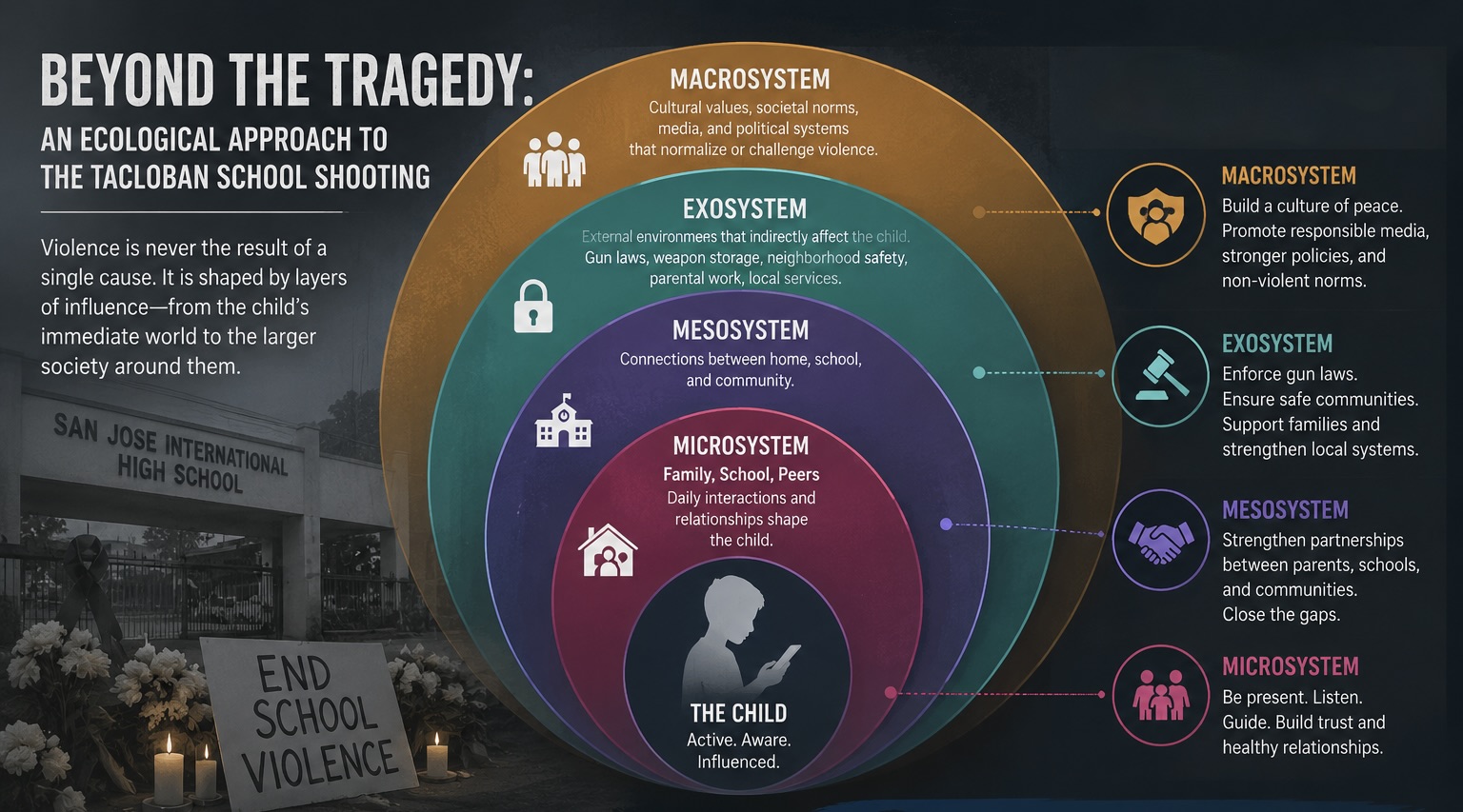
As public debates become increasingly polarized, Senator Risa Hontiveros, chair of the Senate Committee on Women, Children, Family Relations, and Gender Equality, issued a crucial clarification on June 30: “I never recommend, said, or even thought about banning any game, including “GoreBox”. Instead, Hontiveros directed her July 1 committee inquiry toward a far more insidious threat: the systematic exploitation, grooming, and radicalization of minors within unmonitored online spaces.
The Senate panel revealed that the Tacloban tragedy might be the Philippines’ first mass shooting incident linked to “764”, a highly decentralized, international online extremist network operating within a broader digital subculture known as “The COM” or the “True Crime Community” (TCC). Formally designated as a national security threat by the United States federal authorities and a terrorist group by Canada, 764 promotes Nihilistic Violent Extremely (NVE) – an ideology asserting that human life has no value and that civilized society must be dismantled.
Rather than using video games as a direct training simulators, these extremist groups use them as a multi-layered recruitment pipeline:
1. The Exposure Phase – recruiters slip into highly interactive, popular gaming platforms like Roblox, Minecraft, and GoreBox. They exploit platform algorithms to locate children who are lonely, socially isolated, or struggling with mental health issues.
2. The Transition Phase – once a connection is established, the groomers systematically move the children off public platforms and into private, encrypted servers on Discord and Telegram.
3. The Coercion Phase – away from public view, adult groomers use intense psychological coercion, blackmail, and a systematic isolation from their families to demand escalating acts of self-harm, animal cruelty, or real-world violence.
In the Tacloban case, investigators flagged a dummy Facebook account names “Date Larping” belonging to one of the underage suspects, which received messages of support from suspected 764 affiliates immediately after the attack. The committee highlighted a comment from an alleged adult groomer using the name “Sedykh Ryazanov” who instructed the minor: “Na-edit kita boy sa TikTok. Make sure na delete mo Discord, Reddit, Telegram para walang evidence na mahanap.” (I edited you already on Tiktok. Make sure you deleted your Discord, Reddit, and Telegram accounts so no evidence is found). Hontiveros argued that while video games themselves are not direct cause of the violence, the unmonitored digital environments surrounding them require strict state oversight. She asserted that large technology companies and platform developers must be held legally accountable for failing to implement sufficient safeguards, emphasizing that child safety should not be compromised for corporate profit. Senator Bam Aquino, however, has mounted a firm opposition to any legislative efforts aimed at restricting or banning video games, characterizing such moves as a recurring historical distraction.
The legislative debate between senators Hontiveros and Aquino reveals that modern Youth violence cannot be solved by a single policy intervention. Hontiveros’ inquiry into the “764” network highlights the reality that international security threats can bypass physical borders and enter the home through an unregulated digital spaces. At the same time, Aquino's critique of blanket video game bands serves as a warning against the reactionary policies that are more present physical security gaps, loose gun laws, and the social isolation of minors.
The debate between Hontiveros and Aquino ultimately reveals that campus violence is no longer confined to either physical spaces or digital ones. Children move constantly between both worlds, and policy must evolve accordingly. Treating online extremism and real-world vulnerabilities as separate problems risks overlooking how they increasingly reinforce one another.