Notes From the Road, In a Year of War
Wika · Culture · July 4, 2026
Discover Notes From the Road, In a Year of War — a deep dive into Culture.
In her book The Future of Nostalgia, the critic Svetlana Boym defines nostalgia as, “an ache of temporal distance and displacement”: not just the desire to return to a place, but the fantasy of returning to another pace of time. The very root words which make up nostalgia (nostos or “homecoming” and algos or “suffering”—put together: suffering from the inability to return) already betray its nature: there is no such thing as returning to that different when. We have no choice: we can only move forward.
We are here because even in 2010 or 2016 or 2022, the giant machine we all live in had its gears turning, its compass pointing to this timeline. History happens in nudges. And here we are: nudging against this now, trying to reorient it to a kinder elsewhere. Our feet are firmly planted in this present: post-February 24, 2022 (Ukraine), post-October 7, 2023 (Palestine), post-February 28, 2026 (Iran), with Turbo Diesel at 140.20/L, with jeepney drivers crying on the news because they cannot feed their families with their PhP 36 pesos per day take-home; with corporate office workers collapsing from heat on their morning commutes; with weekly brownouts becoming the norm because the grids are overworked.
And after all this, we wait with dread for Typhoon season.
It’s from this state of inescapable here-ness that I leapt into the 2026 Grana Tour.
All Jokes Are Half-Meant
It begins as a joke with Jane, Grana’s Managing Director. In December of 2025, still reeling from battling Christmas rush traffic and the ordeal of hauling books (Jane) and a projector with metal stand (me) down the busy Makati streets, we settle into the first installment of The Poem is Plural, a craft talk wherein I, together with fellow poets Austere and Rilke talk about poetry and how it can be so many things (poetry as surrealist art, poetry as prose poem hybrid, poetry as short story).
Soooo, Jane asks me, as we watch Austere giving his portion of the seminar. Ano gagawin natin as overachievers next year?
This is a running joke: Grana has published over fifteen titles in the three years since they began in 2023. They are always thinking of something new to do or working on something that they thought of a few months before, or both. In that way, I feel my busy mind has found kindred spirits.
And so I reply, Gusto niyo ba magtour?
Jane’s eyes light up. Game! Let’s do it!
At that moment, we laugh at the joke, but all jokes are half-meant, and we would, in fact, find a way to do it.
Istorya Studios, Bulacan - April 9, 2026
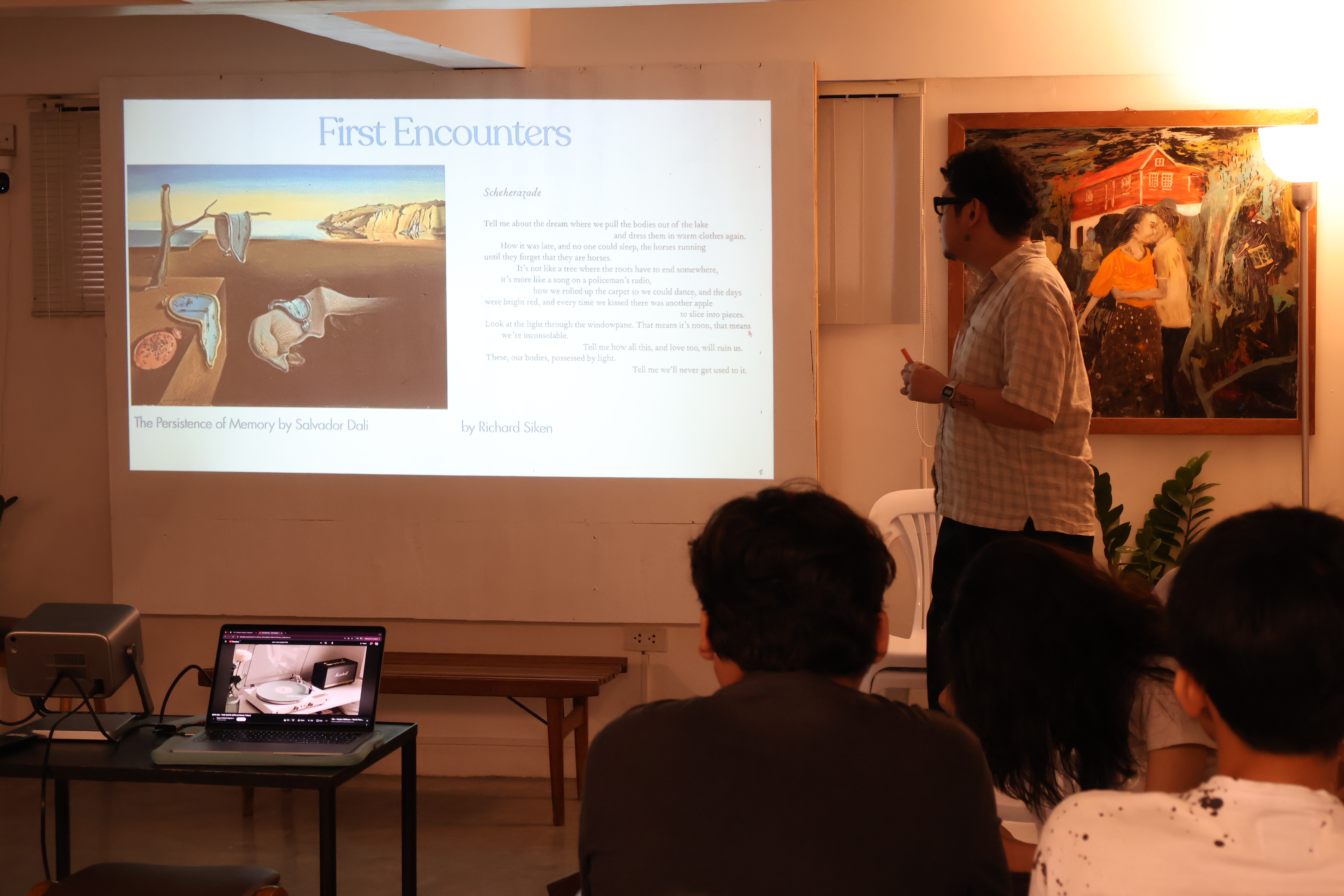
Istorya Studios is the kind of place that everyone has seen on their Instagram feeds: poetry readings in the al fresco area, coffee in the brutalist-slash-mid-century modern Kape Lunan, booktubers thoughtfully through well-curated bookshelves.
The 1080 x 1920 px rectangle of IG Reels doesn’t prepare us for the sheer size of Istorya Studios. From your screen, you imagine the place to be small and cozy as many contemporary art-devoted spaces tend to be (think Everything’s Fine in Makati or Lost Books in Cebu). But Istorya is huge. The ceilings are high enough that several lifesize statues of Manananggals hang from the ceilings with their maletas in tow, without compromising the headspace.
The workshop space is on a second floor mezzanine that overlooks the bookshop; we’re told that the third floor is going to house a gallery (it opened in late April). We leave Manila early (around 6:45 AM) and by the time we get to Istorya Studios, we shake off the road’s dazed lethargy and start to feel a buzz: partly anxiety, mostly excitement.
We set up the mic, the laptop, the books, and as the participants start to pile in, there’s a certain charge in the air: This is it, it’s really happening!
And it does: sure, we fumble some jokes, we awkwardly ask people to socialize, we get frustrated when some activities don’t translate, but still, we power through and at the end of it, everyone is sharing their poems, laughing together, and taking poetry jabs at one another (o sige nga, ano’ng constraint mo?).
As we decompress at a bulaluhan after, we talk with excitement about the day: what went wrong, what went right, what we didn’t expect—and the unspoken under all of it is what we’ll do differently next time.
Alfredo F. Tadiar/Puón Books, San Fernando, La Union - April 18, 2026
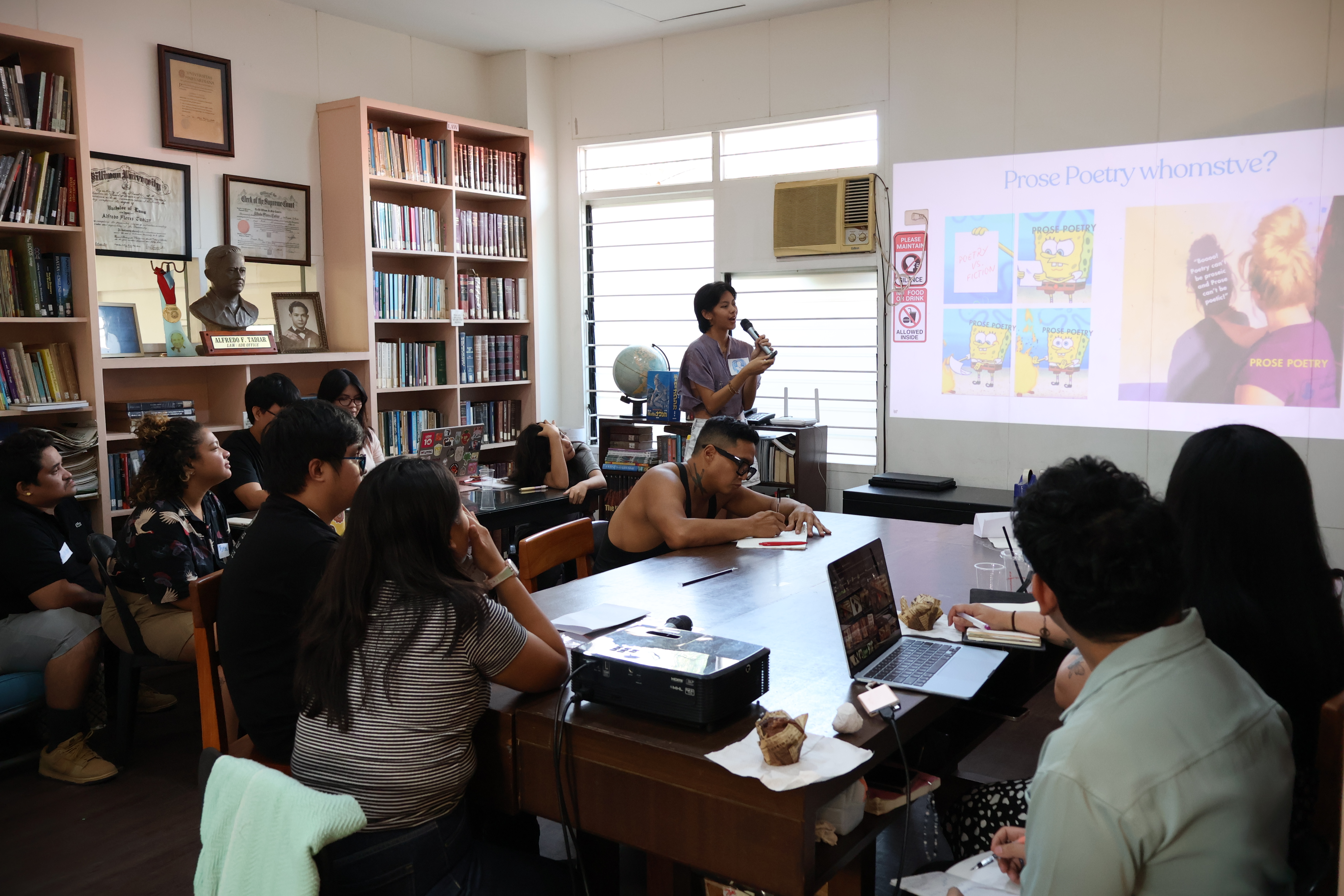
It’s on the La Union (Elyu to the young and hip) leg of the tour that we really feel the effects of the war in a practical way: we wait five hours at the Partas terminal before the bus finally arrives at 2:00 AM. We’re informed that buses usually arrive on an hourly basis, but since gas prices are so high, they’re cutting back on the number of trips per day. This is particularly brutal for me because I’d just done two all-nighters in a row, thanks to a big event at my corporate day job. Nonetheless, red-eyed and exhausted, we pile onto the bus, put on our headphones, and fall asleep the minute we hit NLEX.
We wake up to the 7:00 AM sun hitting the San Fernando bend on Mc Arthur Highway. Of all the stops, I am most excited for Elyu because we were being hosted by Neferti X.M. Tadiar, one of my dissertation’s big sources, and we would spend the morning at Balay Da Judge, the Tadiar ancestral house which has now been turned into a space for artists’ residencies.
We take Tricycle #1 of the trip to Balay Da Judge, and are greeted at the gate by Ms. Anna, who manages the space. One of the house dogs trails behind her, his tail wagging with excitement. Inside, the house is bright but cool and airy with Amplimesh windows and solihiya furniture that you know has lived a long life. We take a few hours to nap and freshen up before getting our bearings and heading back out.
Tricycle # 4 takes us from a small shawarma place where we grab lunch to Alfredo F. Tadiar Library and Puón books. The bookshop and library are in a split-level house which has the same 50s style architecture: big windows, a slanted roof, and the kind of sunshine that slows time in Northern Luzon.
Here, the crowd is different: not just bigger, but also calmer, older. This was not their first rodeo. On the one hand, we’re excited—Austere puts it like this, Yay into it na sila, so pwede na tayo maging weird!—but on the other hand, we’re suddenly nervous again. Would our presentations be too crazy? Would they find the activities too easy?
The afternoon passes and as it turns out, everything is just weird enough. There are poems about Justin Bieber (this was also post-Bieberchella), about the demon of US Imperialism, about peeing sitting down, about the lasting desire for Rico Yan and Claudine Baretto’s loveteam of the 90s.
We end the day at Tiny Bar LU where the seating capacity is exactly six seats—perfect for me, Austere, Ril, Jane, Ayer, and Aram. We order drinks and read tarot cards: what’s going to happen next?
The next day, Tricycle # 17 takes us back to the terminal.
Mount Cloud Bookshop, Baguio, Benguet - May 9, 2026
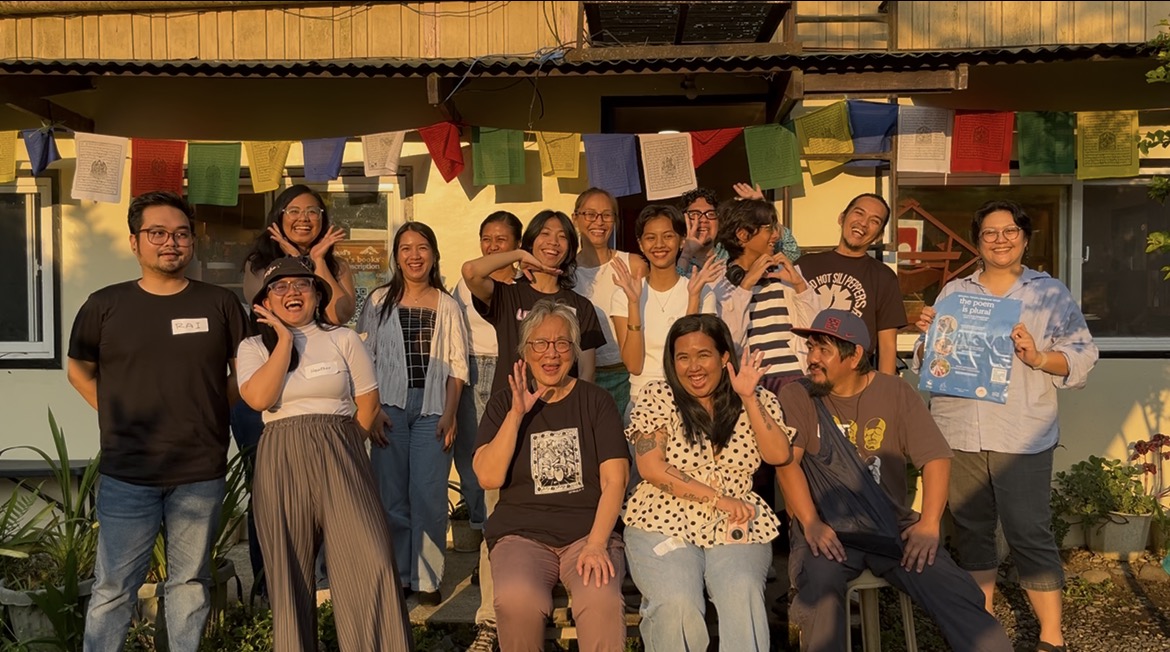
In Baguio, the travel goes smoothly: there’s been a petrol rollback and so the bus is on time and we make it to our lodging at Tulip Apartelle along Loakan Road in time to get a full eight hours of sleep.
The next day (workshop day), we have breakfast at Victoria’s bakery with a view overlooking the city and while the view is serene, we find ourselves living in the turmoil of yet another post: Post-April 19, 2026 (the Toboso massacre in Negros Oriental).
This mingled thread of grief and anguish winds itself through everything we do, every conversation we have on this leg. After all, how could it be that as we were riding the van home from La Union on April 19th, thinking about which snacks to get at the next gas station, students, writers, and community workers were being brutally shot to death elsewhere in the country?
Now, when we talk about surrealism or constraint or a multitude of forms or doing away with hegemonic thinking or the importance of imagination, we find ourselves talking about more than just the poems: we are talking about the need to change the form of this hellscape we call the world.
The workshop space at Mount Cloud is new: it's small and cozy and the group that’s assembled is a mix of students, poets living their double lives as corporate employees, and veteran writers who are regulars at Mount Cloud’s events. In Baguio, there’s a certain depth and calm to the poems which come out of the workshop—our prompts (birdsong, Amoebiasis, asking your seatmate about themselves) turn into poems about resisting being put into a gendered box, poems about the desire to escape loneliness, poems about living so close to the clouds but being unable to fly.
In the Q&A, we are asked questions oriented toward the future: do you think this experimental poetry thing is going to become a movement? Do you think there will be more workshops? Do you think there’s more room for small, independent presses to make a big impact? Do you think Grana is going to become a leader in the resurgence of experimental poetry?
We all look at Ayer, Grana’s Editorial Director for answers.
Well, Ayer says, weighing his words. Hindi natin concern yun. Kasaysayan ang huhusga doon. Ang trabaho natin ay magsulat.
-Article by Wina Puangco-Mutuc, Contributor